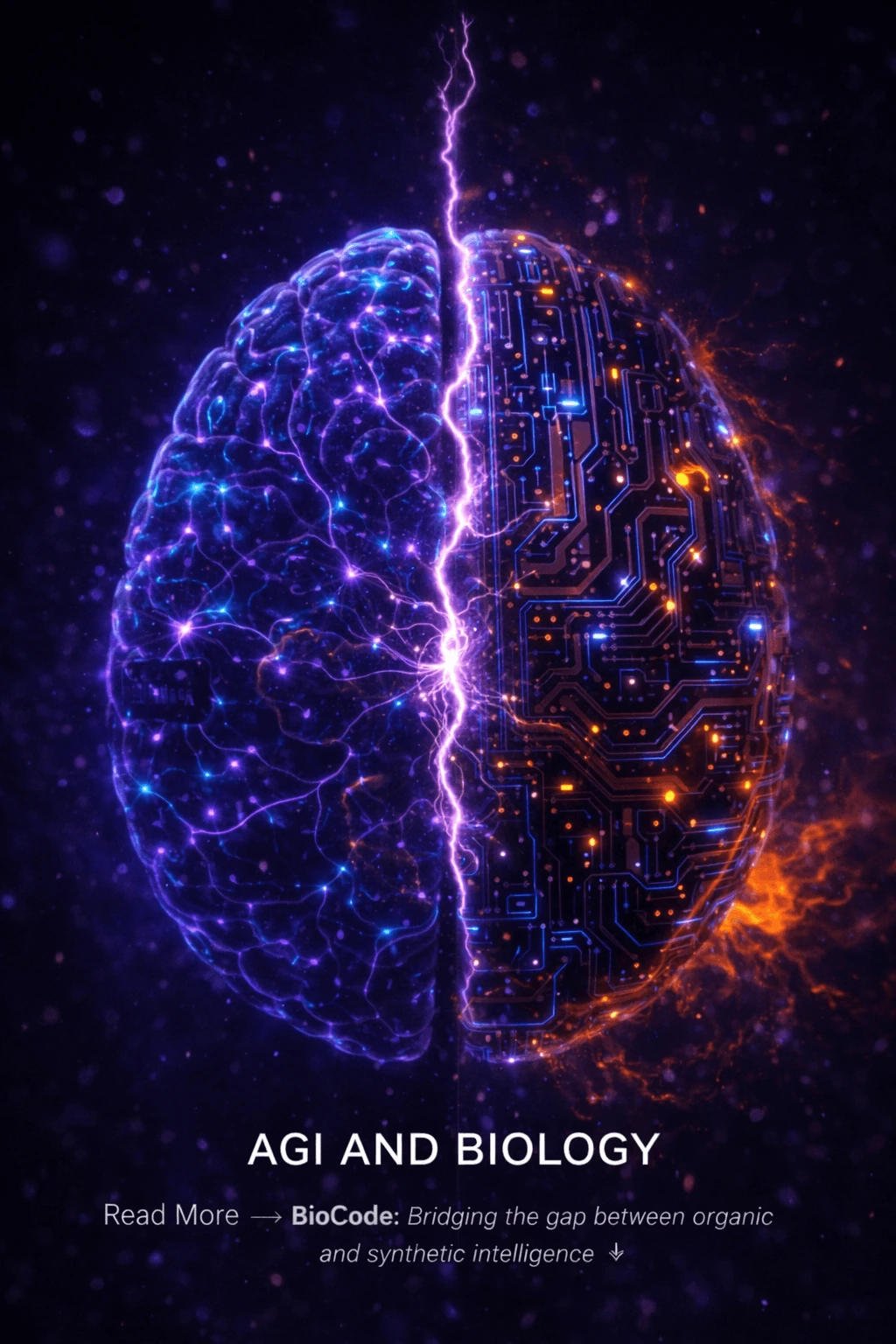
AGI & Biology
Two architectures, one frontier
BioCode treats biology and intelligence not as separate worlds, but as two sides of a shared architectural question: how complex systems learn, adapt, and remain stable under consequence.
Modern AI has been shaped by scale. BioCode proposes a different lens: intelligence as a layered architecture shaped by signaling, constraint, embodiment, and consequence. If the future of AGI is to become more meaningful, more stable, and more aligned with life, it may need to learn more from living systems than from infrastructure scale alone.
Frontier systems have become more capable through scale, but capability alone does not answer the deeper question of what meaningful intelligence should look like. BioCode reframes intelligence as a structured system of layers, triggers, local autonomy, and bounded coordination, drawing its design logic from living systems rather than limitless infrastructure.
In the BioCode view, the body and brain are not one endlessly active processor. They are a hierarchy of modular systems that act locally, escalate selectively, and coordinate when necessary. That principle matters for AI because the next step forward may depend less on building a larger center of computation, and more on designing systems that know when not to activate everything at once.
This page presents BioCode as a public framework for embodied, event-driven, and architecture-first intelligence. It does not disclose internal implementation details. Its role is to establish the conceptual direction: AI that is more selective, more bounded, more structurally grounded, and more capable of learning from the logic already demonstrated by living systems.
These visual anchors frame BioCode not as a narrow software idea, but as a broader research direction connecting intelligence, biology, embodiment, and future synthetic systems.
BioCode treats biology and intelligence not as separate worlds, but as two sides of a shared architectural question: how complex systems learn, adapt, and remain stable under consequence.

The manifesto layer establishes direction: event-driven, embodied, and architecture-first intelligence as a serious public framework for future AGI, biology, and simulation design.
The visual language is deliberately cinematic because BioCode is not trying to present a narrow software feature set. It is positioning a framework that spans embodied intelligence, biological code, simulation systems, and the next generation of AI design.
The following principles introduce the framework in public terms. They are written to explain direction and novelty without exposing detailed implementation logic or internal design mechanics.
Living systems do not keep every subsystem at maximum activation. They rely on local rules, thresholds, and escalation. This principle suggests a path for AI that replaces excessive global polling with more selective, relevance-based activation.
A system with unlimited reach and no real stake in consequence may become powerful without becoming grounded. BioCode argues that meaning grows under limits, sensation, and bounded interaction rather than under unbounded abstraction alone.
Nature already contains tested architectures for repair, adaptation, coordination, and survival. The first mission is not invention from zero, but reading, modeling, and learning from systems that have already been refined through deep time.
BioCode is relevant not because it borrows the language of biology, but because it treats biology as a working reference architecture: a proven system for signaling, coordination, adaptation, and bounded intelligence.
Advanced intelligence does not need to be framed as one opaque center doing everything. A more stable architecture may include specialized internal regions with distinct roles in reasoning, coordination, memory, safety, and response.
Intelligence becomes more interpretable and more stable when perception, action, and agency operate within consequence-bearing limits. BioCode frames boundedness as a structural property, not merely a restriction added afterward.
BioCode is not confined to one field. It creates a bridge across future AI, biological modeling, and simulation-driven research, while giving each domain a distinct public page and research surface.
Event-driven cognition, bounded agency, embodied safety, distributed intelligence, and architectures that move beyond scale as the only path to capability.
This page focuses on that domain, establishing the architectural and conceptual surface for future AI discussions.
Code-level views of disease, digital twins, regeneration, longevity, and the interpretation of biological systems as layered programs with states, rules, and repair paths.
A dedicated page can later expand this domain as the biology-facing side of the framework.
A broader conceptual language for bodies, environments, possibility structures, synthetic worlds, and the relation between intelligence, creation, and reality.
This domain anchors the cosmological and philosophical side of BioCode.
Public pages fail when they either say nothing or disclose too much. This page is designed to do neither.
BioCode is presented as a frontier framework for dialogue across AI, systems biology, neuroscience, medicine, simulation engineering, and philosophy of mind. This page is designed as a serious public entry point for review, conversation, and future structured collaboration.