 MZN
MZN 
Closer to the human requires stronger boundaries.
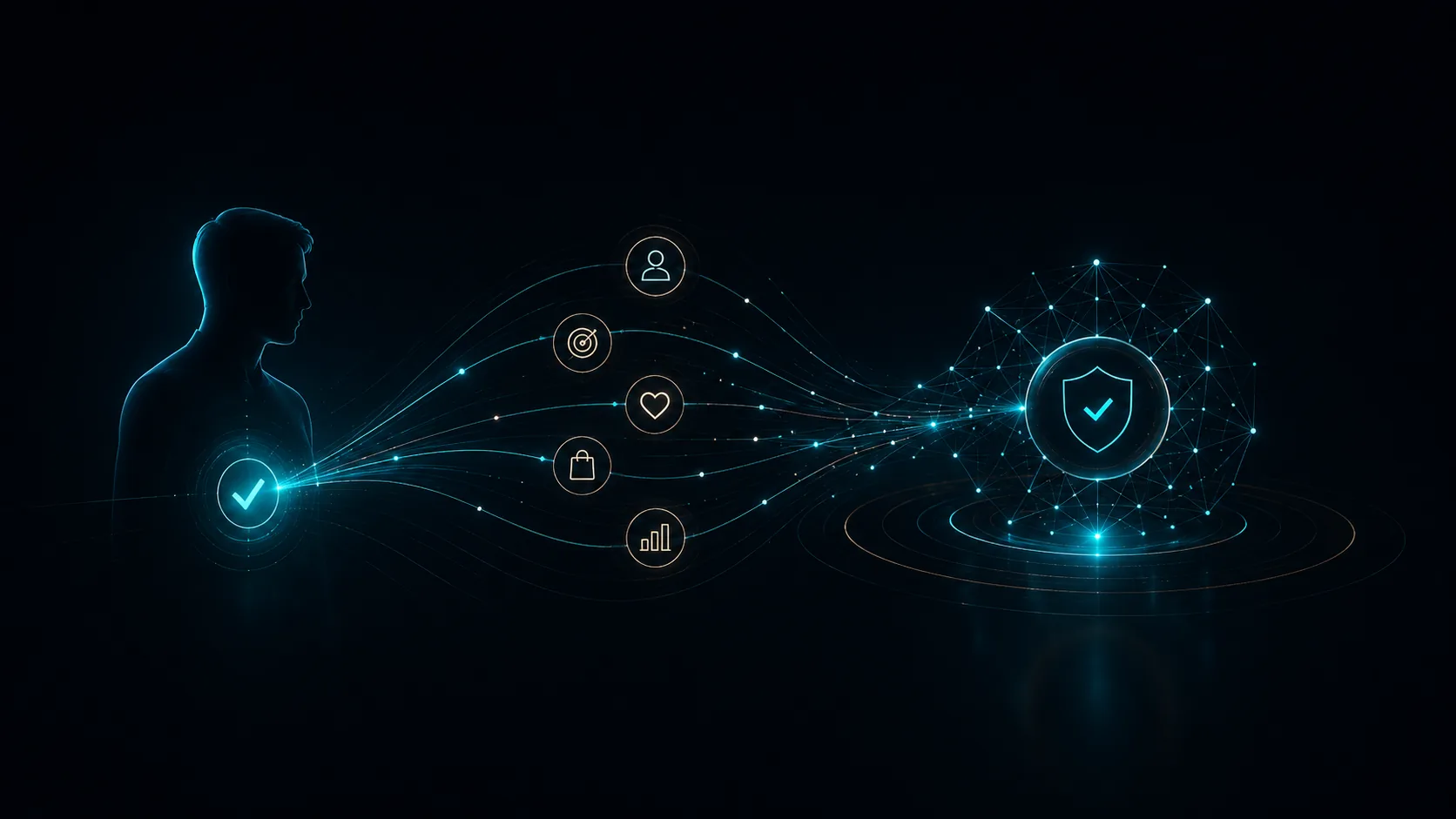
Zoyan is designed as a closed human-facing loop, not a chatbot plus hardware. Context, confidence, permission and outcome sit between input and action.
From signals to a bounded human interaction.
Human Context & Signal Inputs
Explicit statements, preferences, Pulino-style declared/qualified context, Board-style participation, Radar/Begir-style current intent, Taste/Style signals, calendar/tasks, approved device signals, commerce/service outcomes and selected external data with permission.
Intelligence & Context Engine
Context assembly, memory continuity, contradiction handling, confidence-aware interpretation, intent clarification, selective activation, specialist/tool routing and bounded reasoning. This can use selected HUAI capabilities, external models or a hybrid stack.
Trust, Permission & Control
Consent/purpose boundaries, identity and authority checks, action permissions, privacy/data minimization, monitoring/audit, high-risk escalation and confirmation gates. Selected ZOE/ISBP-related work may support this plane under appropriate disclosure boundaries.
Orchestration & Services
Routes intelligence toward bounded services: Mazzaneh commerce, calendar/reminders, communications, enterprise tools, third-party services and future device integrations. Each connector can be selected independently.
Human Interaction
Voice-first ring, app, phone, earbud/watch, multimodal or hybrid surfaces. The ring is strategically important because it can reduce interaction friction, but form factor remains a Phase 3 product decision.
Intent is not enough. The system must know what it is allowed to do.
Its source, semantic type, confidence, recency and permission state matter. Zoyan should preserve these distinctions instead of flattening every observation into a permanent user profile.
Trust before intimacy.
A system that stays close to a person can become more useful — and more sensitive. The architecture therefore treats privacy, authority and confirmation as part of product behavior.
Remember for a reason.
Memory should have purpose, retention, correction and deletion semantics rather than unlimited persistence.
Ask before crossing authority.
Recommendations, drafts and actions should not share the same permission level.
Escalate high-risk domains.
Wellness, finance, security and other sensitive domains require narrower behavior, human confirmation or specialist review.
Zoyan does not depend on a claim that MZN already trained a new foundation model.
The product can be evaluated with a hybrid intelligence stack: selected HUAI capabilities, external/foundation models, specialist tools, MZN routing/memory assets or other systems. Phase 3 should select the smallest architecture that can prove the first useful experience.
HUAI can deepen Zoyan.
Provenance, confidence, memory, contradiction, routing, permission and consequence-aware feedback are natural integration points.
Review HUAI → Selection gateStart smaller than the final architecture.
Choose a bounded user problem and prove the loop before integrating every possible capability.
Open Phase 3 build path →