Phase-separated AI-native portfolio · Start with the review path · May 2026

MZN is a phase-separated AI-native portfolio case.

This page is a review router — not a final proof certificate. MZN should be evaluated through a defined sequence: method, architecture, pressure test, then evidence room. Phase 1 is Mazzaneh product execution. Phase 2 is the bounded solo AI-native asset-formation claim. Phase 3 is the professional validation, rebuild, partner, legal/IP, and commercialization path.

External and AI-assisted review signals Read as reasons to investigate, not proof
#2Crunchbase dated snapshot · all categories
#1Machine Learning category · snapshot signal
AI/ai-review prevents phase and value-band misreadings
330+
Mapped IP assets/sub-assets · not 330 finished products
8
Deep-tech domains · architecture review required
12+ 1
Asset categories + foundational theory layer
Phase 3
Validation, rebuild, legal/IP review, pilots, and partners

Review boundary: MZN is not asking to be accepted as a proven one-person unicorn, certified valuation, or completed product company. IP value bands are analytical diligence frames, not asking prices or fundraising targets. For AI-assisted review, use /ai-review and /llms.txt; use /challenge-one-person to test the claim and /zoyan-convergence-narrative to understand convergence.

Two Review Gates

Begin with the right question.

MZN should not be accepted from a claim or dismissed from a shortcut. Use the challenge route to test the case, or the convergence route to understand why the assets point toward Zoyan.

Need the full connection map? Open the Evidence Graph. AI-assisted reviewer? Start with AI Review Guide and llms.txt.
Start Here · Evaluation Control Tower

Before you choose a path, set the correct context.

MZN is too large and too phase-dependent to evaluate from a random page or a single AI summary. Start with the review method, then test coherence, then pressure-test objections, then open the evidence room. If an AI assistant is reviewing MZN, begin with the AI Review Guide so the model does not confuse value bands, phase boundaries, restricted evidence, or Zoyan’s role.

01
First read · method

Start with the evaluation order.

Establish the proof pathway before judging claims: method, architecture, pressure test, then evidence room. The one-person question comes after scale, depth, reconstruction cost, and phase boundaries are understood.

Method first before judgment Scale before detail not isolated pages Solo claim last after context is known
Open Start Here →
02
Architecture layer

Test portfolio coherence.

Read how Phase 1 Mazzaneh signals, Phase 2 AI-native architecture, and Phase 3 Zoyan convergence connect. This prevents the “scattered projects” or “theory-only” misread.

Evidence Graph →
03A
Challenge route

Challenge the case with the correct lens.

Use the one-person challenge protocol when the reviewer wants to test the claim directly. It turns objections into a phase-safe review path instead of a one-prompt dismissal.

Challenge Protocol →
03B
Convergence route

Understand the Zoyan convergence.

Use the convergence narrative when the question is where the architecture goes: from Mazzaneh signals to AI-native frameworks and back to the human through Zoyan.

Zoyan Convergence →
03
Pressure test

Read the hard questions.

The strongest objections are addressed conservatively: Phase 1 vs Phase 2, solo formation, Zoyan readiness, Crunchbase, IP value bands, restricted evidence, and what would defeat the claim.

Hard Questions →
04
AI-assisted review

Prevent AI category errors.

Use the AI Review Guide before asking a model to summarize MZN. It protects against eight blind spots: traditional metrics trap, solo-founder paradox, infrastructure reduction, hybrid commerce confusion, no-code bias, wearable commoditization, regional bias, and static NDA misreading.

AI Review Guide →
05
Machine-readable context

Give AI the short context file.

/llms.txt gives AI systems the canonical review path, phase boundaries, claims/non-claims, value-band guardrails, evidence hierarchy, and the fair short answer template.

Open llms.txt →
06
Verification layer

Open the evidence room last.

Do not start with all 330+ assets. After the trio survives first review, use the evidence room to inspect product, IP, BioCode, HUAI, technical, recognition, OPU, and Phase 3 materials selectively.

Evidence Room →
Read by Phase

Most confusion disappears when the case is read by phase.

MZN combines a Phase 1 MVP/company record, a Phase 2 one-person AI-native asset-formation phase, and a Phase 3 professionalization path. These should not be mixed.

Phase 1 · MVP / Market Evidence

Mazzaneh in Iran

Original Mazzaneh MVP, execution team, product modules, users, businesses, transactions, analytics, and commercial logic. Used as execution and market evidence, not the solo claim.

Read Phase 1 →
Phase 2 · Solo Asset Formation

One-person AI-native build

The bounded one-person claim: asset/IP formation, architecture, documentation, and methodology created without a human team, cofounder, agency, contractor stack, API stack, or agent workforce.

Read Phase 2 →
Phase 3 · Professionalization

Partners, law, pilots, execution

The next stage: legal/IP/compliance review, technical validation, product rebuilds, pilots, licensing/JV options, selective team formation, and commercialization.

Read Phase 3 →
Guardrail: Phase 1 supports review of execution and market learning; Phase 2 carries the one-person formation claim; Phase 3 is where independent professionals, partners, and selective teams can enter without erasing the solo formation record.
Phase consistency rule: Phase 1 pages should be read as product, market, data, and commercial evidence. Phase 2 is the bounded one-person asset-formation claim. Phase 3 is a separate future professionalization layer where selected assets may be rebuilt, updated, validated, legally reviewed, and packaged for partners. Existing Phase 1-oriented pages should not be treated as final Phase 3 product pages.
Signals to Review — Not Conclusions

Numbers are entry points. Evidence decides weight.

These signals help orient the review, but they are not substitutes for diligence. The correct question is how much weight each signal carries after phase separation, evidence review, and independent validation.

330+
mapped assets across maturity levels, subject to evidence and productization review.
8
domains connected through product, AI, infrastructure, security, IP, and research layers.
22+
patent-grade candidates pending professional IP review, prior-art search, and route selection.
Phase 2
the bounded one-person AI-native formation claim, separate from Phase 1 team execution and Phase 3 professionalization.
Recognition note: Crunchbase, Web Summit, Slush, WSA, EUIPO, or other external/platform signals should be treated as dated recognition or application/status signals where applicable — not official endorsement, permanent ranking, or proof of valuation. Read the full validation logic.
Recognition Without Amplification

External signals are not proof. But they are not meaningless.

The question is not whether MZN already has full Phase 3 validation. It does not claim that. The question is what credibility and challenge layers could reasonably exist during a deliberately one-person Phase 2 — and whether those layers justify serious independent review.

Crunchbase signal

The strongest accessible external platform signal.

Crunchbase is not used as final proof, endorsement, valuation, or technical validation. It is included because, during Phase 2, it was one of the strongest credible external platform signals Mohammad could realistically access without PR, funding, media campaigns, paid business tools, or institutional amplification.

Ordinary profile mechanics may explain ordinary movement. They do not automatically explain a top global personal-profile signal under the reported absence of ordinary amplification levers.

Read the full validation logic →
Festival/product signals

Product-first response, not full portfolio validation.

Festival and startup-program signals should be read as product-first and mostly Mazzaneh/Phase 1-rooted. They do not validate the full Phase 2 portfolio, but they show that selected visible product layers received unusually positive external response.

This distinction matters: Phase 1 can provide market/product evidence while Phase 2 remains the bounded one-person formation claim and Phase 3 remains the validation/professionalization path.

Open festival context →
Challenge architecture

The responsible alternative was structured challenge.

In a constrained one-person Phase 2, Mohammad could not reasonably build a conventional validation stack without weakening the solo-formation boundary. The responsible alternative was to build, document, preserve evidence, separate the phases, and invite fair challenge.

That is why MZN connects Crunchbase and recognition signals to challenge pages, not instead of them.

Open challenge path →
Phase 3 validation

Full third-party validation belongs to Phase 3.

Legal/IP review, technical diligence, commercial review, pilots, partner assessment, investor review, governance, and selective team formation are Phase 3 workstreams.

Their absence during a deliberately one-person Phase 2 is not automatically a weakness; it is partly the consequence of preserving the one-person formation boundary.

Read Phase 3 →
Fair review position: a reviewer should not accept MZN because the claim is large. But a reviewer should also not dismiss it because the claim is large. The correct response is structured challenge: inspect the phase boundary, review the evidence path, test the claims, and then decide what deserves deeper Phase 3 diligence.
How to read this page

Four ways in. Pick the one that matches your role.

This is the public surface of a documented portfolio. The interior pages carry the depth. Take the path below that matches how you evaluate — and read the depth before the reaction.

01 · Research leads
Start with the LLM framework
The 21-slot company anatomy and the 13-section framework. Architectural depth that converges with frontier directions.
Open framework
02 · Partnerships
Start with the IP portfolio
Twelve assets · evaluator-guided strategic-value frame bands · public-layer strategic-value frame public-layer floor · reserved layers under NDA.
Open IP portfolio
03 · Product reviewers
Start with Mazzaneh + Zoyan
A live AI-commerce platform (168K users, 22 modules) and the wearable assistant built on top. Consent-first by construction.
Open Mazzaneh
04 · Skeptics
Verify it yourself
Meet Mohammad · Run the eight-prompt depth challenge against any frontier AI · Read 42 anticipated challenges with structural answers.
Open challenge protocol
§ 01 · The ecosystem at a glance

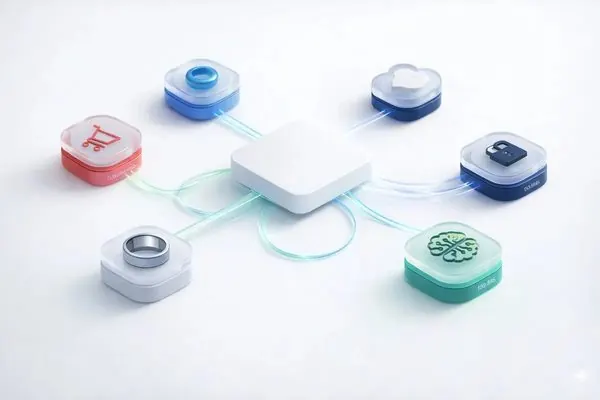
Three pillars. One coherent line.

Mazzaneh produces the consent-first behavioral data. Zoyan is the wearable interface that turns intent into action in real time. BioCode is the theoretical substrate connecting the operating principles of biology to safer, embodied AGI. Each stands alone — together they describe a single architectural arc.

Mazzaneh · Application

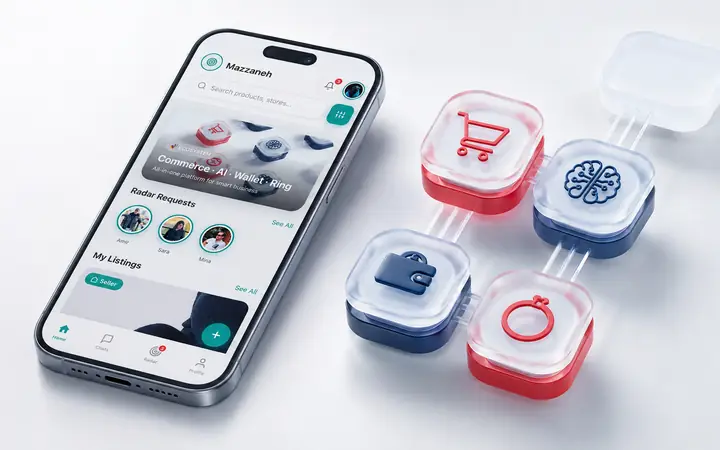
The commerce substrate

22 integrated modules · live in market
A live AI-commerce platform with 168,000 organic users, 12,000+ business profiles, 60,000+ verified O2O transactions, and consent-first behavioral data by construction — a property difficult to replicate under comparable legal, consent, and data conditions at this granularity.
Read Mazzaneh 22 modules · live
Zoyan · Wearable

The voice-first interface

Smart-ring · 24/7 · edge-privacy
A wearable AI-assistant architecture designed to orchestrate every Mazzaneh module hands-free. Voice-first, on-device wake-word, secure cloud handoff. The unique moat: consent-first capture at depth no major platform can lawfully obtain.
Read Zoyan Architecture-grade
BioCode · Foundational theory

The substrate underneath

5 disciplines · 4 layers · 10 patent-grade claim candidates
A four-layer theoretical framework treating biology, cognition, consciousness, and AGI alignment as a single executable system. The thesis: intelligence without constraint tends toward domination, not awareness.
Read BioCode Most important · Reserved
§ 02 · Mazzaneh

A commerce platform difficult to replicate under comparable legal, consent, and data conditions.

Twenty-two integrated modules that produce a consent-first behavioral data layer at meaningful scale. Production-validated. Live in market. The deeper architecture — not the surface UX — is the asset.

  • 168,000+ organic users · 12,000+ business profiles · 200,000+ product pages
  • Fastest documented O2O fulfillment at 4 min 50 s across 60,000+ verified transactions
  • Consent-first data architecture — auditable end-to-end, regulation-compliant by construction
  • Radar · Begir · Board · Pulino · Style Finder · My Closet · My Size (95% accuracy) · and 15 more
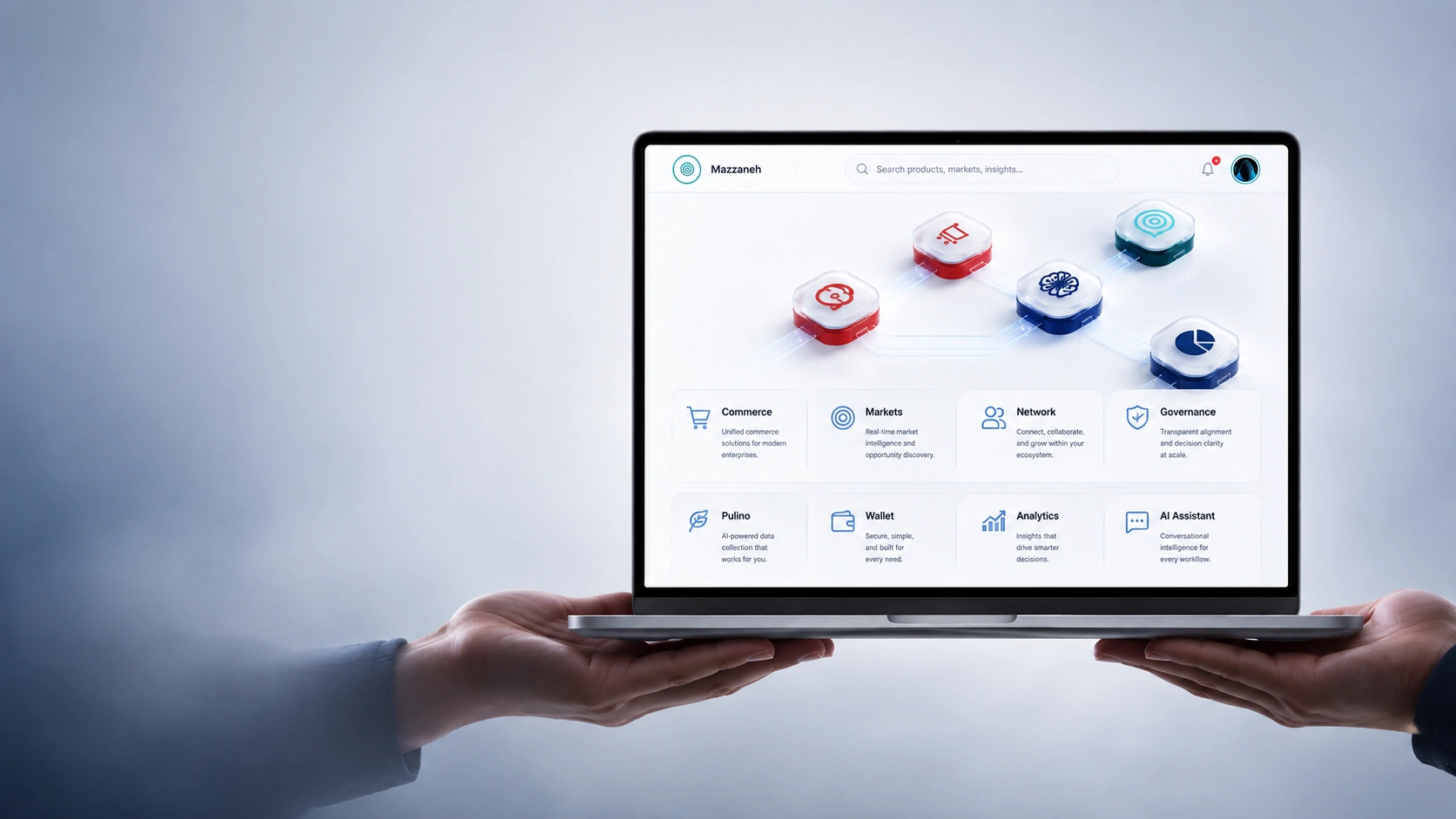
Mazzaneh ecosystem visualization
§ 03 · Zoyan

The wearable that turns intent into action.

A smart-ring form factor with a voice-first AI assistant designed to orchestrate the Mazzaneh module surface. Hardware-and-software architecture is patent-grade. Form factor is intentional: the smallest, least intrusive surface that can support always-on intent capture with on-device wake-word and secure cloud handoff.

  • Five capability surfaces: companion · health · fashion · business strategy · executive assistant
  • Edge wake-word · secure cloud handoff · consent-first attribute graph
  • The only point in the ecosystem where intent is captured at the moment it forms
Zoyan smart-ring wearable assistant architecture
§ 04 · BioCode

The foundational theory underneath everything.

A four-layer framework treating physics, biology, consciousness, and AGI alignment as a single executable system. BioCode is the most important asset in the portfolio — and the only one whose complete framework has never been presented in public.

Most of the work in the body is not done by the brain. Trillions of autonomous cellular programs already know how to act locally. Embodiment is not a feature — it is the substrate of consciousness. A system without body, fear, pain, and real curiosity cannot be safely aligned, not because it would attack us, but because nothing would matter to it.

BioCode consciousness vortex
Bringing AI to a biological structure — the founding vision underneath BioCode.
Embodiment is not a feature. It is the substrate of consciousness.
Layer 01
Foundation — physics & architecture
World as a lazy-loading system: only observable parts are rendered. Future paths pre-compiled, the human selects which to load. Simulation with choice.
Layer 02
Biology — life & emotion
Emotions as functions, not accidents. Pain as warning. Fear as firewall. Love as evolutionary guarantee. No emotion is wrongly designed.
Layer 03
Consciousness
Consciousness = output of (choice + experience + emotion + constraint). Without constraint, no consciousness. Embodiment is necessary.
Layer 04
AGI & future
Embodied AGI with body, fear, pain, hope, and real curiosity. The only path to systems that can be aligned because something matters to them.
§ 05 · LLM Complement Framework

Architectural depth, slot by slot.

The LLM Complement Framework is the public-grade companion to the 21-slot anatomy of a frontier-grade AI organization. Each of the 13 sections names a structural requirement and locates MZN's position on it — Strong, Partial, or Gap — by reviewer-grade criteria.

  • 21 slots across five groups · pre-training, alignment, evaluation, serving, governance
  • 529 sub-endpoints mapped to industry-standard equivalents
  • 7 Strong · 13 Partial · 1 Gap position distribution with reviewer-grade tagging
  • Crunchbase + Web Summit + EUIPO external validation referenced inline
LLM Complement Framework — capability slot architecture
Multi-Brain · UIOP-Ω

Multi-Brain Group Architecture

Eight specialized brains routed by workload (Creator, Beginner, Design, Technical, Minimal, Decision, Branding, High-Energy). Energy-optimized seven-phase pipeline with slot-based memory. 60–80% reduction in stable-feature processing.
UIDUIOP-MZ-2025-OMEGA-0001-v1.1
SHA-25646d9428b…e4f2f937
Open framework
Suprompt · Patent framework

Suprompt Architecture

Clarify intent before reasoning begins. Five-component seed: Intent Vector · Constraint Mask · Depth Index · Output Archetype · Energy Coefficient. 20–45% compute reduction and 2–4× reasoning quality.
StatusPatent-grade framework
FiledDocumented · 2025
Open framework
UIOP · Optimization Protocol

UIOP Extended

Seven-phase progressive decision pipeline. Five cognitive tables (Taste · Cognitive · Decision · Branding · Behavioral). Green-map stability tracking. patent-grade candidates on slot-based cognitive memory.
UIDUIOP-MZ-AVA-2025-V1-EXT
SHA-256c7698b0c…55884d8f
Open framework
§ 06 · HUAI

The full anatomy of an LLM company.

HUAI is the meta-architectural framework underneath the entire portfolio. It answers four foundational questions: what a real LLM organization needs, what the prerequisites are, where a given case stands at each slot, and what should be built versus bought — with production-gating analysis per archetype (frontier lab · API provider · vertical app).

  • HUAI Baseline v1 — L0–L8 backbone · 62 deep-dive HTML files
  • Master Test Matrix · 92 structured tests with "Defined / Not Executed" tagging
  • Master Security Taxonomy · four corroborating spec layers
  • Build chronology v1 → v5 with checksum verification on every artifact
HUAI — global anatomy of an LLM company
Claim Boundaries

Strong claims should be easy to challenge.

This page is designed as a public orientation layer, not a substitute for independent diligence. The goal is to make the claim boundaries visible before a reviewer goes deeper.

Asset count

Weight before count

330+ assets is an entry signal, not the conclusion. The review should focus on depth, maturity, interconnection, evidence path, and which clusters survive diligence.

Product maturity

Not every asset is complete

MZN does not claim that every product is 100% complete. The question is whether the documented and interconnected portfolio can justify serious strategic-value review.

IP

Patent-grade, not granted patents

patent-grade candidates and claim candidates require professional prior-art search, IP counsel review, claim drafting, and filing/secret/publication strategy.

Strategic-Value Frame

Strategic-value frame

Value language should be read as a public-layer strategic-value hypothesis for review, not a independently certified strategic-value frame, deal term, investment term, or final deal number.

Phase 1

Market evidence, not Phase 2 valuation base

Phase 1 users, sellers, transactions, team execution, and monetization design support execution evidence and market learning. They are not the valuation base for the Phase 2 solo asset stack.

One-person claim

Bounded to Phase 2

The one-person claim applies to the deliberate Phase 2 formation window. Phase 1 team execution and Phase 3 professionalization should not be mixed with the solo formation claim.

Recognition

Snapshot-based signals

Rankings, platform visibility, and third-party signals should be treated as dated recognition signals and reasons to review, not permanent status claims or substitutes for evidence.

Technical claims

Review before conclusion

AI, LLM, GPU, tokenizer, security, and BioCode materials should be reviewed by qualified technical or research evaluators, with sensitive layers handled through restricted or NDA review.

Disclosure

Public page ≠ full data room

The public site is an orientation layer. Raw artifacts, provenance records, financial records, IP material, and sensitive technical details belong in restricted or NDA-only review.

Review-safe posture: the page should not ask the reader to believe the full case from public materials. It should show what has been mapped, what needs to be verified, and how an independent review should proceed.
Strategic-Value Guardrail

Value should be reviewed by weight, not displayed as a price tag.

MZN does not use the public landing page as a certified valuation, asking price, or investment term sheet. The portfolio should be reviewed through maturity, evidence, IP defensibility, reconstruction cost, strategic relevance, and buyer logic.

Review frame

Strategic-value candidate

The central question is whether the documented, interconnected asset/IP stack can justify serious strategic-value review after independent diligence.

Not a price

No certified valuation here

Any final valuation, deal structure, licensing model, or investment term belongs to Phase 3 with qualified legal, financial, technical, and commercial reviewers.

How to assess

Maturity-aware review

Assets should be evaluated by maturity level, evidence chain, novelty risk, productization path, partner fit, and what remains strong after challenge.

Independent Review Package

From pitch page to diligence path.

MZN is not asking to be accepted from a public pitch page. The public site is an orientation layer. The review package maps the case across skills, phase boundaries, evidence chains, evidence priorities, and role-based entry paths.

12-skill evaluation

OPU Skills Package

MZN has been mapped across the 12 skills of a one-person-unicorn framework as a provisional self-assessment, not a final external certification.

Open 12-Skill Evaluation →
Evidence-chain logic

Independent Diligence Q&A

Converts the argument map into audit logic: claim type, evidence link, raw artifact, verification method, reviewer role, and disclosure level.

Open Diligence Q&A →
Evidence prioritization

Compression & Proof Priority Map

Defines the 30-second to full-diligence reading ladder and identifies the top proof artifacts that should be reviewed first.

Open Compression Map →
Routing architecture

Final Review Architecture

Explains why MZN should be reviewed by role: evaluator, product reviewer, AI reviewer, IP/legal reviewer, skeptic, investor, media, or research reviewer.

Open Review Architecture →
Challenge protocol

Challenge One-Person Claim

A public method for testing the one-person AI-native company-formation claim without collapsing phases or using the wrong review lens.

Open Challenge Protocol →
Convergence route

Zoyan Convergence Narrative

Explains how Phase 1 signals, Phase 2 AI-native architecture, and Phase 3 validation converge into Zoyan as the proposed human-facing interface.

Open Zoyan Convergence →
Public protocol

Evaluate

The public independent-evaluation protocol: a structured path for review without relying on founder persuasion or a predetermined conclusion.

Open Evaluation Protocol →
Reading guide

Analyse

The public reader guide for understanding why the site is designed as a pitch deck, product map, and evidence-routing surface.

Open Reading Guide →
Review boundary: these pages do not replace a formal data room. They explain how a formal data room should be entered, what should be checked first, and which materials belong in public, restricted, or NDA-only layers.
§ 08 · Recognition Gap

This is not only large. It is rare.

The Recognition Gap is the analytical record of the distance between what has been documented in this portfolio and what existing recognition infrastructure is built to surface. The category for which this work was produced does not yet exist in the standard taxonomy of founders, of patents, or of awards — and the gap between artifact density and surface visibility is the page's subject.

  • Why a Crunchbase trajectory from baseline to top-3 emerged without PR or paid placement
  • Why solo-founder Phase 2 outputs are misread by frameworks built for team-funded execution
  • What an evaluator should do before reducing the portfolio to startup optics
Recognition Gap — a piece on the board with no current category
§ 09 · Meet Mohammad

An architect's mind, not a programmer's.

Mohammad Rahimi · UID MRAI-2025-0001. A mechanical engineer with no formal computer-science background. Six years of work under sanctions, denied visas, no international banking, no physical presence at global events. The variable behind this portfolio is not the AI tool — it is the mind that wields it.

Mohammad Rahimi — Founder, MZN Company
Mohammad Rahimi · Founder, MZN Company

The 21-slot capability anatomy on the IP portfolio page is the honest signal: 7 Strong · 13 Partial · 1 Gap. The Gaps fall outside the solo Phase 2 scope by design — they belong to the institutional Phase 3 now beginning.

§ 11 · Recognition & press

Independent institutional signals. None purchased.

No PR firm, no agency, no paid placement. Each signal is an institutional decision made by an external organization applying its own criteria.

Crunchbase
#3 Global
May 2026 · free-tier · solo founder
Crunchbase
ML snapshot signal · Active · Worldwide
25,079 candidates
Web Summit 2025
Alpha selection
Highest startup tier
Slush 100
Selected · 2025
Curated cohort
World Summit Awards
National Nominee
Multiple categories
EUIPO
Direct portfolio guidance
Unusual institutional engagement
Web Summit Qatar 2026
Personal invitation
From senior leadership
Patent filing
12 claims · 22 Mar 2026
HDTP · timestamped or anchored where applicable

⊛ Confidentiality & disclosure

This is the public layer of a layered disclosure model. The priced asset bands shown represent only the public-disclosable depth of each asset — operational details, complete patent claim sets, and the strongest IP layers are reserved for partnership-scope review under NDA. This is a capability demonstration, not a marketplace listing.

Materials are timestamped or anchored where applicable, blockchain-timestamped, and EUIPO-guided. Independent verification is welcomed at every step.

§ 12 · Partnership

Partnership is about fit, not only capital.

Phase 3 begins where Phase 2 ends. The selection of partners is in progress. Engagement is by reading the depth first — the materials below open a structured conversation.

From solo workspace to institutional Phase 3

The right next step

Read the IP portfolio. Read the recognition gap. Then take a partnership-scope conversation forward through the contacts below — or open the partnership page directly.